



Living in Mauritius all year round: what is daily life like for expat families?
There is the Mauritius we imagine before moving there — the lagoon, the climate, the slower pace of life — and then there is the reality of everyday life, once the children are settled in school, the first medical appointment has taken place, and family life has found its rhythm. It is often at this precise point that the real decision takes shape: whether to stay for a few months a year, or make the island a true base for the whole family.
For families considering a long-term move, three topics consistently rank among the main concerns: healthcare, schooling, and the practical organisation of everyday life. Here is what you really need to know about each of these aspects, without glossing over the realities, so that you can approach this decision with the same peace of mind that the Mauritian lifestyle promises.

Healthcare, schooling, practical aspects of daily life, connectivity... everything you need to know before settling in Mauritius as a family.
Healthcare in Mauritius: a system worth understanding
Mauritius has a free public healthcare system, accessible to all residents, including expatriates. On paper, it is a genuine safety net: regional hospitals, local health centres, 24-hour emergency care. In practice, the vast majority of expatriate families turn to the private sector, for reasons of speed, comfort (private rooms, more recent equipment) and access to certain specialities.
The private establishments most often mentioned by the expatriate community — Clinique Darné, C-Care, Wellkin — offer a standard of care comparable to European benchmarks, with doctors frequently trained abroad. Costs remain noticeably more accessible than in Europe: a GP consultation costs around €30, a specialist consultation between €30 and €60, and surgical procedures typically cost 30 to 50% less than in Europe for a comparable operation.
This level of comfort does, however, come at a cumulative cost, particularly in the case of hospitalisation: taking out international health insurance is therefore strongly recommended, and is even mandatory under certain residence permits. For the most serious cases requiring care unavailable locally, medical evacuation remains an option, notably to Réunion Island, which is quickly reached from Mauritius by air.
In short: the quality of care is no obstacle to settling in Mauritius, provided insurance is arranged from the outset, rather than treated as a last-minute administrative detail.
Special cases: maternity care, chronic conditions and long-term follow-up
Two situations deserve particular attention when a family settles in Mauritius for the long term. The first concerns maternity care: many expatriate mothers choose to give birth in Mauritius, in one of the private clinics equipped for pregnancy monitoring and delivery, at costs noticeably lower than those charged in Europe. It is nonetheless essential to check that the insurance policy taken out actually covers this type of care, as some entry-level policies exclude it.
The second concerns the follow-up of chronic conditions (diabetes, hypertension, or conditions requiring regular specialist monitoring). The Mauritian private sector covers most common specialities, but certain highly specialised disciplines remain less represented than in major European hospital centres. Families in this situation are advised to speak with local doctors, or with other expatriate families already settled on the island, to confirm in advance that the necessary follow-up care is genuinely available locally.
Schooling: a rich offering that calls for forward planning
This is often THE question that determines, more than any other, whether a long-term family relocation is realistic. The good news: the range of schools in Mauritius is genuinely broad and varied, built specifically to welcome children of expatriates from all over the world.
Three main pathways coexist. The French network, accredited by the AEFE (École du Nord in Mapou, Lycée La Bourdonnais in Curepipe), follows the French national curriculum, a choice favoured by families anticipating future mobility within the French international school network. International schools (notably Northfields and Westcoast) offer Cambridge or International Baccalaureate curricula, within a resolutely English-speaking and multicultural environment. The Mauritian public system, which is free, follows the British model and remains an option for families seeking fuller local immersion, although it is rarely chosen by expatriates.
Budgets vary considerably depending on the pathway chosen: expect to pay roughly €2,000 to €4,000 a year for a French school, and somewhat more for the international circuit. One point not to overlook: places at the most sought-after schools are booked 12 to 18 months in advance, with genuine waiting lists at certain levels (particularly primary and the start of secondary). For a family preparing to relocate, this lead time needs to be factored in from the very first planning stages, well before the property search itself.
For families who prefer a more flexible solution — while finalising a move, for remote-working parents who don't intend to settle on the island long term, or simply as a deliberate educational choice — distance learning through CNED, combined with local social activities (sport, art, groups of children from the area), is an increasingly common alternative among expatriate families settled in Mauritius.
Everyday life: what genuinely changes once you've settled
Beyond healthcare and schooling, it is the organisation of everyday life that determines whether a family truly feels at home in Mauritius, or experiences the island as an extended pause.
Language is rarely a major obstacle: French and English coexist naturally in daily life, in administration as in shops and services, alongside Mauritian Creole as the everyday language between Mauritians.
Driving is on the left, as in the United Kingdom — an adjustment for many new arrivals, but one that is generally mastered within a few weeks. The road network is decent on the main routes, though traffic can be heavy at peak times around Port Louis and Ébène, which is worth planning around.
Everyday essentials — supermarkets, shopping centres, pharmacies, home services — are well provided for across most of the island, with a particularly strong offering in the north (Grand Baie), the west (Flic-en-Flac and Tamarin) and the central plateau (Ébène and Moka). Certain specific products or medications may occasionally require a little extra organisation to source, but this remains a minor consideration set against the overall level of comfort.
The climate is worth planning for beyond the postcard image: cyclone season runs from November to April, with occasional events that can temporarily disrupt schools and activities. This is not a reason to rule out relocating, but it is something to factor into the yearly rhythm rather than discover once on the ground.
Connectivity, finally, is no longer a barrier for families where one or both parents continue to work remotely: fibre broadband now covers a large part of the island, including the most sought-after residential areas. The limited time difference with Europe and the Middle East makes it easier to keep up an international career without disrupting family life.
The wellbeing factor: what Mauritius genuinely offers families
Beyond the practical considerations, there is a simpler truth that explains why so many families, once settled, never leave: the Mauritian pace of life profoundly changes one's relationship with time. Children grow up outdoors, surrounded by nature, in a multicultural environment that naturally opens them up to other languages and other ways of seeing the world. Parents, for their part, often rediscover a work-life balance that is hard to recreate elsewhere — a stable climate year-round, outdoor activities within easy reach, and a sense of security within close-knit communities.
It is no coincidence that so many expatriate families describe settling in Mauritius as a genuine improvement in quality of life for the whole household. Provided, precisely, that the three pillars outlined above — healthcare, schooling and the organisation of everyday life — have been properly thought through in advance.
Building a network: the social side of settling in
One point often underestimated before relocating, yet decisive for the success of a family's move, is how easily a social network can be built once on the ground. The expatriate community in Mauritius is large, active and particularly well organised around families, with numerous support groups, parent associations and activity clubs that make the first few months considerably easier.
Schools, in fact, play a central role in this social integration, well beyond their educational function: it is often through school that families form their first lasting friendships, exchange trusted recommendations, or help one another with day-to-day logistics (shared school runs, occasional childcare, all manner of local tips). For a family settling in Mauritius, choosing a school is therefore never a purely educational decision: it is also, indirectly, a way of choosing a first social circle.
Where to settle as a family in Mauritius?
In the south-west of the island, Domaine d'Anbalaba offers a distinctive way to live out this family relocation.
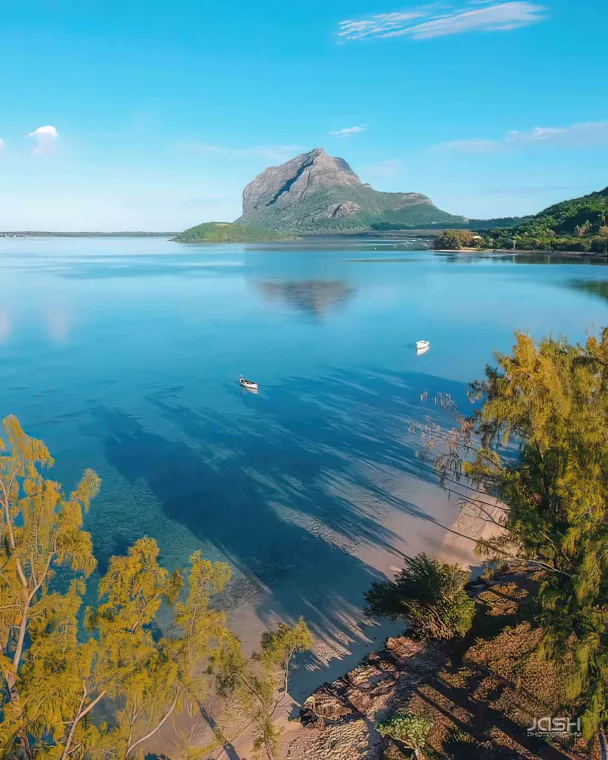
Part of the fabric of life in Baie du Cap, close to the lagoon and Le Morne, the estate brings together a natural setting, outdoor space and services designed to simplify everyday life. Families can enjoy a peaceful residential setting while staying well connected to the activities, shops and schools of the west coast. For those looking to make Mauritius their main home, or to spend several months a year on the island, the challenge is no longer simply finding a beautiful villa, but finding a setting in which the whole family can genuinely build its everyday life.
Frequently Ask Question about family life in Mauritius
Yes, provided you prioritise the private sector for routine care and take out international health insurance. Costs remain lower than those in Europe for a comparable standard of care.
Which school system should you choose for your children in Mauritius?
It depends on your family plans: the French AEFE network for continuity with the French education system, international schools (Cambridge, IB) for a distinctly English-speaking environment, or the Mauritian public system for full immersion in local life.
How far in advance should you enrol your children in a school in Mauritius?
Ideally, 12 to 18 months before the desired start of the school year, particularly for primary and early secondary school, where waiting lists are common at the most sought-after schools.
Is French enough to manage everyday life in Mauritius?
Yes, French is widely spoken and understood, both in administration and in everyday business, alongside English and Mauritian Creole.
Should you take the cyclone season into account when organising family life?
Yes, the season runs from November to April. Significant weather events remain occasional, but they can lead to temporary disruptions to schools and activities, which should be factored into the annual routine.
What criteria should you prioritise when choosing where to live in Mauritius as a family?
Being close to schools, shops and healthcare services is essential, but the living environment matters just as much. For a long-term move, it is important to find the right balance between tranquillity, access to family activities, connectivity and proximity to the main hubs of daily life.